
With the announcement by the Transport Minister of New Zealand Chris Bishop that high emission penalties that are currently charged to import vehicles whose carbon dioxide levels are above a certain limit would be slashed by 80% many thought this would mean it would ease the burden on the consumer’s pocket. In fact that is what was the explanation provided by the ministry suggesting that the fees had become an unnecessary cost burden for the importers and that would trickle down to the consumer eventually. In the words of the minister – “At a time when Kiwis are still feeling the pinch, the last thing they need is the cost of cars going up by hundreds, or even thousands, of dollars – but unless the Government acts urgently to fix the Clean Car Standard, that’s exactly what could happen,”
The announcement on beehive.govt.nz came along two more specifics – a Fact Sheet which is available here and a list of vehicles that would see cost benefits from the introduction of this bill. Here is the list provided on the government website:
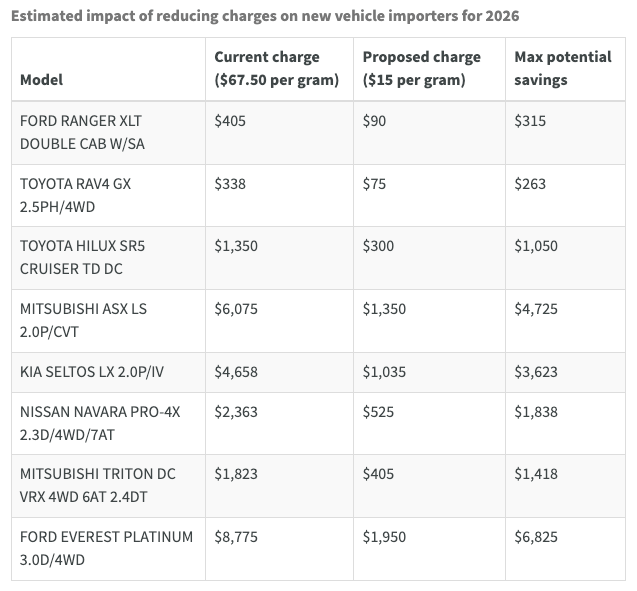
If you read the Fact Sheet that is available on beehive. govt. NZ you might be left wondering who actually benefits from this? It starts by saying that the Bill would help to make NZ’s fleet more efficient, which doesn’t seem possible when the list of vehicles that would benefit from this rate cut are mostly high emission vehicles. Apart from the RAV4 Hybrid all the above vehicles have a tailpipe emission higher than the rate set by the government’s Clean Car Standard. To get a better understanding of how the Clean Car Standard works you can read my other post here.
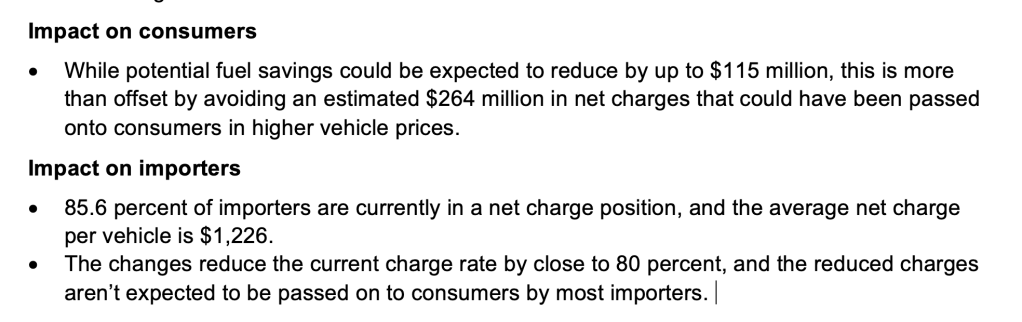
The proposed bill also says the projected fuel cost savings to the end consumer that would be made by importing efficient vehicles, is less than the projected cost that consumers would have to pay for importing less efficient (and with higher tailpipe emissions). This is quite a crazy argument because of the two reasons below.
– The proposed Bill itself quite literally states that any perceived savings to the importers would not be passed on to the end consumer. That’s quite an oxymoron if you ask me. Here is a screenshot from the Fact sheet:
– NZ vehicle sales data for 2025 suggests that Ford Ranger and Toyota Hilux which have dominated the new car sales in New Zealand for the past few years have shown about 20% drop in their 2025 year-to-date sales at the end of the third quarter. The new winner is the Toyota RAV4 hybrid. This clearly shows that New Zealand’s average car buyers are moving away from diesel options and making more efficient and cleaner choices.
To summarise, I would like to add that more incentives should be provided to importers for bringing in the type of vehicles that consumers want and not what is more profitable for the importers. For dealers and distributors in New Zealand, diesel vehicles would be cheaper to import as Japan and most European countries have stricter emission standards (Euro 6 and higher equivalents) and manufacturers worldwide would want to dump vehicles that do not meet these standard into countries where the standards are lower. New Zealand currently has an emission standard equivalent to Euro 4 and probably the only nation with an advanced economy to not have a stricter emission standard. As a consumer, this is definitely not a win for you. As an importer or distributor, you may be stuck with stock that no one wants to buy. Think about it. This is not a WIN-WIN for anyone.
#nz #climateaction #cop30
Sources:
New Zealand Government – https://www.beehive.govt.nz/release/easing-cost-new-and-used-imported-vehicles#:~:text=Table_title:%20Estimated%20impact%20of%20reducing%20charges%20on,Proposed%20charge%20($15%20per%20gram):%20$1%2C350%20%7C
Focus2move – https://www.focus2move.com/new-zealand-best-selling-car/


Leave a comment